Managed AI · How our agents work

Agents that finish the job.

A chatbot answers a question. An agent runs a loop — planning, acting, checking its work, and going again until the goal is met. Atwood designs that loop to be reliable over the long haul, and governed on every single turn.

The agent loop

One cycle, repeated until done.

Every Atwood agent works in the same fundamental rhythm. The difference is what happens at the center: each turn passes through Nunc, where policy is enforced, PII is stripped, and the action is logged.

Nunc policy · redact log · memory Plan Act Observe Reflect
1 Plan. The agent breaks the goal into the next concrete step, using the member context and rules it’s allowed to see.
2 Act. It calls a real tool through the gateway — query a CRM, draft a message, update a record — never just talk about it.
3 Observe. It reads the result, checks whether the step actually worked, and catches errors before they compound.
4 Reflect. It decides: keep going, retry differently, or hand off to a person — then loops back to plan the next step.
Two patterns we build

Long-horizon agents & loop agents.

The same loop, tuned for two very different jobs — sustained, multi-step work versus focused, iterate-until-right work.
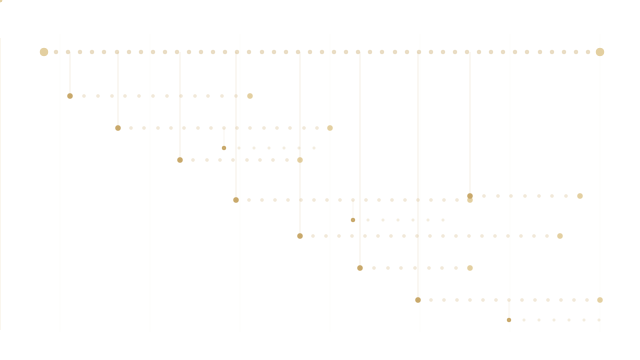
A long-horizon agent orchestrating many sub-agents across a timeline

A coordinator breaks the job into a DAG of parallel sub-agents — routing some to specialized coding agents — then fans them back into one synthesized result.

Long-horizon agents

Work that spans many steps — or many days.

Built to stay on a goal across long task horizons without losing the thread. They hold memory and state, checkpoint their progress, recover from failures, and sequence work across multiple systems.

  • Persistent memory & goal state
  • Checkpointing & error recovery
  • Multi-step, multi-system sequencing
  • Human checkpoints at key moments

Good for: member re-engagement campaigns, reconciliation across systems, research and synthesis over your archives.

Loop agents

Iterate until it’s right, then stop.

Focused on a single objective, a loop agent repeats — refine, retry, self-correct — until a clear exit condition is met. If it gets stuck or hits a guardrail, it escalates to a person instead of guessing.

  • Defined goal & explicit exit condition
  • Self-correction & bounded retries
  • Quality checks before completion
  • Escalation when blocked

Good for: drafting and refining outreach, cleaning a dataset to a standard, resolving a request end-to-end.
How agents compose

Agents that reason over your knowledge — not just your prompts.

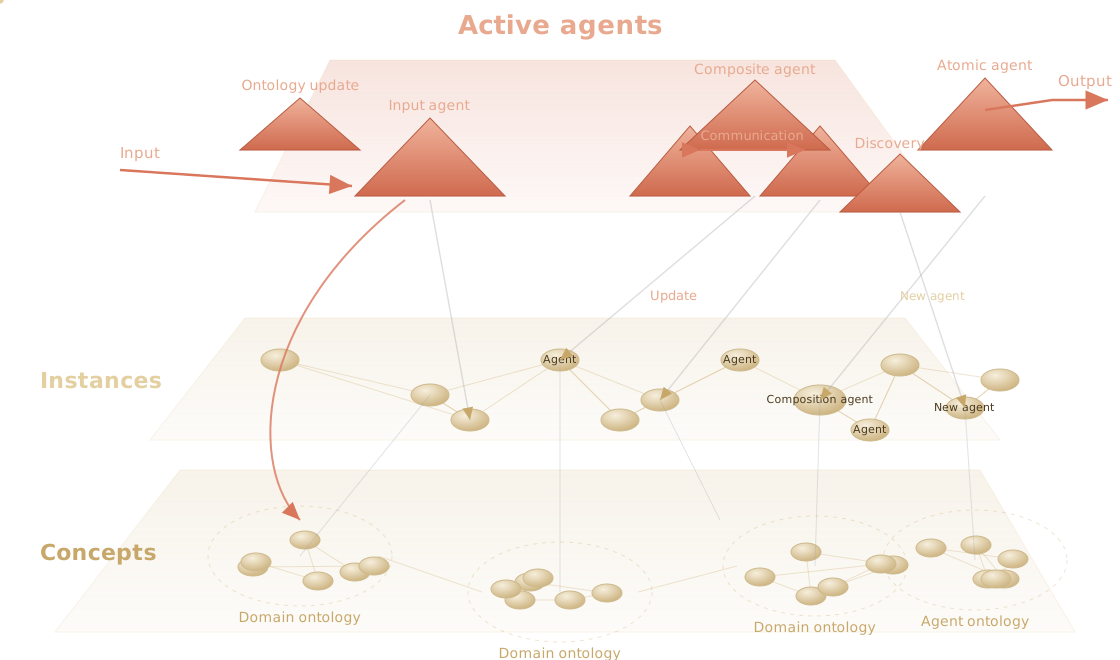
Agents don’t float free. They’re grounded in three layers: the concepts that model your domain (ontologies), the instances of real data and live agents, and the active agents that take input, compose, communicate, discover, and produce output — updating the layers beneath them as they learn.

A three-plane agent architecture: domain and agent ontologies at the Concepts layer, agent instances at the Instances layer, and active agents that turn Input into Output by composing, communicating, and discovering
Input flows into active agents that compose and communicate; discovery spins up new agents; every result updates the instances and ontologies underneath — a system that gets smarter about your world over time.
Governed every cycle

An autonomous loop you can still trust.

Autonomy without governance is how AI goes wrong. Because every turn of the loop runs through Nunc, more iterations means more oversight — not less.

Policy at each step

Every action is checked against role-based access before it runs.

🔒

PII stripped

Sensitive data is redacted before it ever reaches the model.

Fully logged

A complete audit trail of every plan, action, and result.

Isolated execution

Untrusted code and tools run in a sandboxed runtime with no access to your app secrets, torn down after each run.

Bring your own agent

Already use Claude? It runs this same loop.

You don’t have to adopt our agent. Connect Claude — or Claude Code — to your systems through Nunc, and it runs in this same governed loop: policy, PII stripping, and audit on every turn.

See how it works →
A loop in the real world

Example: re-engage at-risk members.

A long-horizon agent, watched the whole way. One goal, several cycles, every step on the record.

1

Plan

Identify members whose engagement has dropped and whose renewal is due this quarter.

access scoped to membership data
2

Act + Observe

Pull attendance and activity from Cvent and Salesforce; confirm the pattern before acting.

PII stripped · action logged
3

Reflect

Segment by why they disengaged, and draft a tailored outreach for each segment.

drafts held for review
4

Human checkpoint

A team member approves or edits the drafts before anything is sent.

human-in-the-loop
5

Loop

Track responses, follow up with non-openers, and report results — then exit when renewals close.

exit condition met · sandbox torn down
Let’s build

What should your agents actually do?

Bring a workflow that takes too long or too many systems. We’ll show you the loop that handles it — safely.